
Although the global pandemic seems to be a thing of the past, many questions about travel paperwork still raise legitimate concerns. When planning to come to Poland in 2026, foreigners often wonder whether their standard medical policy is sufficient in case of a sudden illness. Fear of high medical costs and uncertainty about whether dedicated covid insurance is still mandatory, are key issues that require a clear and precise answer based on current regulations.
In this article, we explain in a factual manner what the current legal requirements are for insurance coverage for visitors to Poland. We analyze whether standard medical policies provide adequate protection if you contract COVID-19, and suggest what steps you should take to guarantee your full health and financial security during your stay. Our goal is to provide you with complete knowledge that will allow you to travel without fear and with a sense of complete security.
Key Takeaways
- Special COVID-19 insurance is no longer a formal requirement for entry, but a standard medical policy remains essential for your safety.
- Find out why most standard medical policies now treat COVID-19 on par with other sudden illnesses.
- Learn to analyze the General Insurance Terms and Conditions (GICs) to fully understand your coverage.
The post-pandemic era: How have COVID insurance regulations changed?
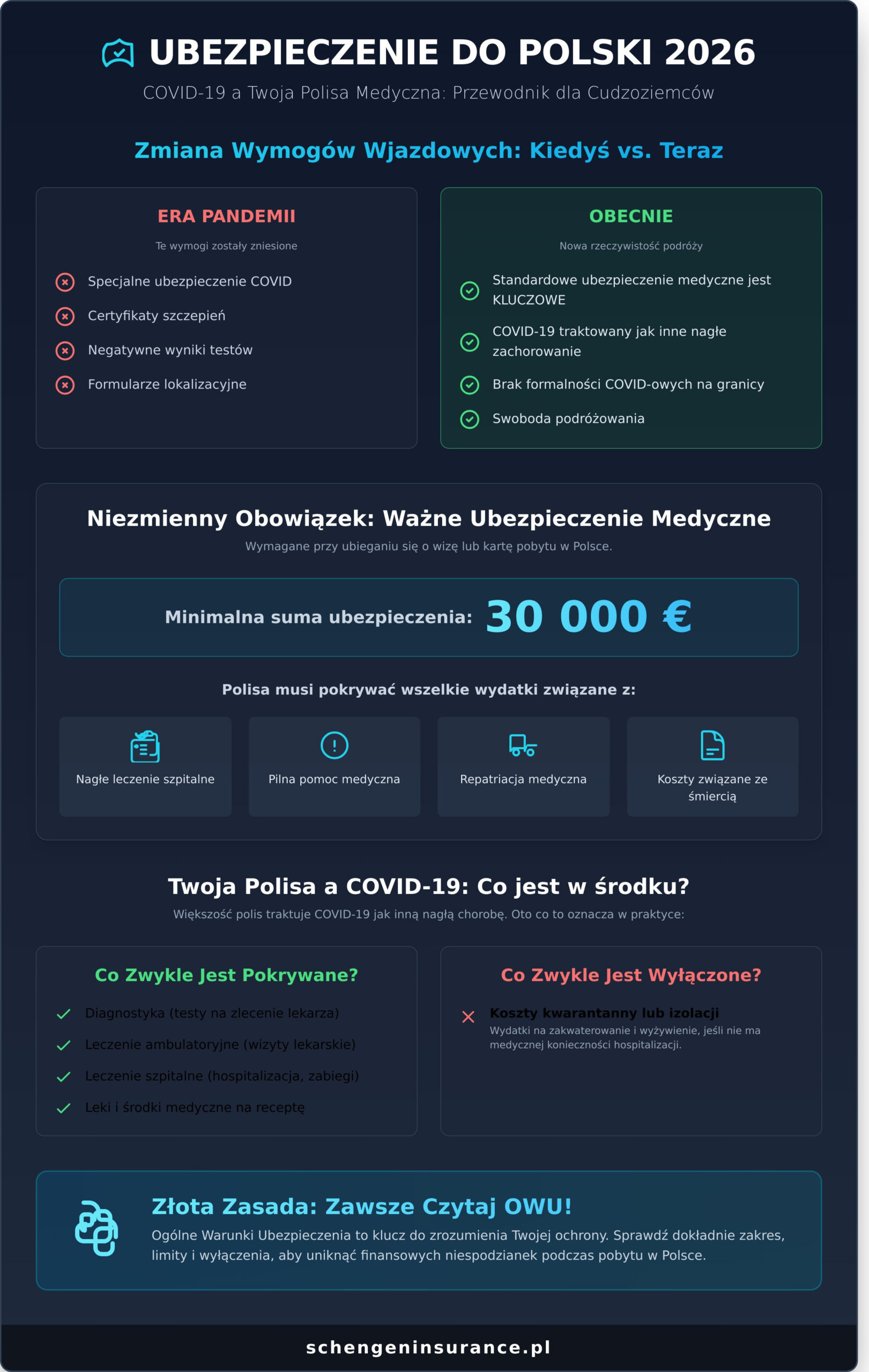
The global health situation has stabilized, leading to a significant liberalization of entry regulations around the world, including in Poland. Requirements that had been standard procedure for years - such as showing vaccination certificates, negative test results or filling out location forms - have been mostly abolished. This change has simplified travel, but shifted more responsibility to the travelers themselves in terms of medical security.
To better understand the current realities of travel insurance, you may want to check out the video below:
No more certificates and tests
Crossing the Polish border is no longer associated with the obligation to present medical documentation related to COVID-19. The removal of the requirement for vaccination certificates or pre- and post-arrival tests is a signal that the disease is now treated by health systems as one of many risks, rather than a unique threat. For insurers, this means integrating coverage for COVID-19 into basic policies, rather than offering it as a separate, often more expensive product.
Current requirements for visa and residence card holders
It should be noted that although dedicated covid insurance is no longer a separate formal requirement, the obligation to have adequate medical insurance for foreigners applying for a visa or residence card remains unchanged. According to European Union regulations, each applicant must have a policy with a minimum sum insured of €30,000. It must cover any expenses that may arise in connection with:
- The need to return for medical reasons (repatriation),
- urgent medical attention,
- emergency hospital treatment,
- death.
These days, a solid policy is more important than ever. Medical costs in Europe can be very high, and failure to have adequate coverage can lead to serious financial consequences. The bottom line is to have a policy that acts as a standard travel insurance, covering a wide range of medical events, including sudden illnesses - including on COVID-19. This provides peace of mind and financial security for the entire period of your planned stay in Poland.
What does standard medical insurance for foreigners say about COVID-19?
As the global epidemiological situation has stabilized, insurers' approach to COVID-19 has normalized. Today, in the vast majority of standard medical policies for foreigners, COVID-19 is treated like any other sudden infectious disease. This means that there is no longer a need to seek special, dedicated covid insurance. However, it is crucial that the policy you have offers broad and reliable coverage for medical expenses.
Infectious disease treatment coverage in the policy
Good quality medical insurance covers medical expenses (CL) incurred as a result of sudden illness, including COVID-19. Such coverage should include comprehensive medical care necessary for recovery. Standard coverage includes:
- Diagnostics: covering the cost of tests and examinations recommended by the doctor to confirm the diagnosis.
- Outpatient treatment: Medical appointments and specialist consultations.
- Inpatient treatment: The cost of hospitalization, treatments and medical care while in the facility.
- Drugs and medical supplies: Reimbursement of drugs prescribed by the doctor.
However, it is always recommended to carefully read the General Insurance Terms and Conditions (GIC) to verify any exclusions of the insurer's liability.
Will my poliza cover the cost of quarantine or isolation?
It should be noted that standard medical insurance focuses on covering medical expenses, not expenses of an administrative nature. Accordingly, most policies do not cover the cost of lodging and meals during mandatory quarantine or isolation, which is not dictated by a medical condition requiring hospitalization. Such costs are not considered medical expenses. A few insurers may offer special extensions in this regard, but this is not standard.
The key role of the insurance sum
The sum insured is the maximum amount up to which the insurer will cover medical expenses. The minimum sum insured of €30,000 is not only a formal requirement, but above all a guarantee of real security. According to official visa requirements for foreigners entering Poland, is the absolute minimum that a policy must meet. Given the potential high cost of treatment in Poland, especially in the case of complications and the need for long-term hospitalization, it is advisable to consider a higher sum. This provides complete peace of mind and protection against unforeseen high medical bills.
How to check if your policy definitely covers COVID-19 treatment?
Having a travel policy is one thing, but being sure that it covers all key risks is the foundation of a peaceful trip. In the context of infectious diseases, it becomes crucial to verify that you have a covid insurance is in accordance with current standards and whether it contains no hidden exclusions. To be absolutely sure that the policy not only meets your expectations, but also official conditions of entry into Poland, you should carefully examine the General Insurance Terms and Conditions (GIC) document. Below is a methodical guide on how to do so.
Step 1: Find the exclusions section in the T&Cs.
Key information about what insurance does not cover is found in the „Exclusions of Liability” section. It is usually located near the end of the T&C document. Look for key words in it, such as: pandemic, epidemic, epidemic emergency or communicable diseases. Also pay attention to the date of the last update of the document - policies modified after 2020 generally already contain precise COVID-19 provisions.
Step 2: Check the definition of 'sudden illness’
Make sure that the definition of „sudden illness” in your policy does not exclude diseases that have been officially declared a pandemic. In the first months of the pandemic, many standard policies used this provision to deny benefits. However, the insurance market has dynamically adapted. Today, most reputable insurance companies have removed this exclusion, and coverage for COVID-19 illnesses is standard in good travel policies.
Step 3: Contact the hotline or agent
If, after analyzing the T&Cs, you still have any doubts, the best solution is to contact the insurer directly. It is recommended to ask a specific, closed question: „Are medical expenses related to COVID-19 illness fully covered under this policy?”. It is advisable to ask for confirmation of this information in writing, for example in an email, as an additional safeguard. Our policies meet all formal requirements and provide transparent protection in case of illness, eliminating the need for guesswork.
Why is comprehensive protection more important than COVID-19 alone?
Although the pandemic has made many travelers aware of the importance of health protection, focusing solely on the risk of contracting COVID-19 is an insufficient approach. A comprehensive medical policy is the foundation for safe travel, as health risks are much broader and often unpredictable. Having adequate insurance is not only to meet formal requirements, but above all to guarantee real support. The peace of mind that comes from the certainty that you will not be left alone in case of problems is an invaluable value during any trip.
Health risks not related to COVID-19
Travel, especially to a new country, involves many unforeseen events that may require immediate medical attention. Even the best covid insurance will not help with other, much more common problems. Some of the most common include:
- Emergency food poisoning requiring treatment,
- Fractures of limbs or other injuries as a result of an accident,
- Acute allergic reactions to local flora or food,
- The need for urgent dental intervention due to pain or injury.
In such cases, hospitalization, a visit to a specialist or even expensive medical transport to the country of residence may be necessary. In extreme cases, when the state of health does not allow return by standard means of transport, the insurer organizes and finances medical repatriation, the cost of which can reach tens of thousands of zlotys.
Financial consequences of not having insurance
Medical costs in a foreign country can be astronomical, and covering them alone often leads to serious financial problems. Examples medical expenses of a foreigner in the Polish health care system perfectly illustrate the scale of the problem. One day of hospital stay is an expense of several hundred or even several thousand zlotys. A visit to the Hospital Emergency Department (ED) can cost between 400 and 800 zlotys, and specialized examinations, such as an MRI, run into thousands more. The cost of a simple operation, such as the removal of an appendix, can easily exceed PLN 10,000. Compared to these amounts, the cost of an insurance premium is a token expense that protects against the risk of years of debt. Therefore, when choosing a policy, look more broadly than just through the prism of COVID-19 protection, treating it as a comprehensive shield for travel.
Comprehensive protection: The key to a peaceful stay in Poland in 2026
As we enter 2026, the travel insurance landscape has undergone a significant transformation. Although dedicated covid insurance is no longer a major formal requirement, the risk of illness and the associated medical costs remain real. The key lesson, therefore, is to shift the focus from a single risk to the need for a robust, comprehensive medical policy. Instead of asking whether insurance covers COVID-19, make sure it provides broad coverage for any unforeseen health event.
To avoid uncertainty and complicated verification of terms and conditions, the safest solution is to choose a policy that guarantees compliance with applicable regulations. The insurance offered by Schengen Insurance is designed to meet the stringent requirements of the Law on Foreigners and European Union regulations. It is a guarantee of acceptance by all provincial offices in Poland, providing assurance of successful completion of formalities.
Don't let formal issues interfere with your plans. Secure your stay in minutes. Buy online health insurance for foreigner - accepted by authorities! Take care of your peace of mind today and enjoy a safe trip to Poland.
COVID insurance: answers to frequently asked questions
Does Schengen Insurance cover COVID-19 treatment?
Yes, the standard Schengen Insurance policy covers medical expenses related to a sudden illness on COVID-19. This coverage is part of the basic medical and emergency expenses insurance. This means that in the event of being diagnosed with an infection while abroad, the insured has access to necessary medical care, hospitalization and treatment up to the sum insured specified in the contract. The policy meets all formal requirements of international institutions.
Do I need a special COVID insurance certificate for a visa?
In most cases, a standard insurance policy certificate confirming medical expense coverage for the required amount (e.g., €30,000) is sufficient for visa purposes. A separate document is not required. However, regulations may vary depending on the destination country. It is always advisable to verify the current requirements directly with the consulate or embassy of the country to which you are applying for a visa to avoid possible formal complications.
What happens if I become ill with COVID-19 just before I travel?
Standard medical insurance does not cover costs incurred prior to departure. Protection in such a situation is provided by additional travel cancellation insurance. If such an extension is purchased and a COVID-19 illness is confirmed by a medical diagnosis and prevents the trip, the insurer will reimburse the cost of airline tickets, hotel reservations or paid excursions in accordance with the terms of the policy. It is worth considering this option when purchasing insurance.
Will insurance cover the cost of the COVID-19 test, if required?
As a general rule, travel insurance does not cover the cost of COVID-19 tests performed for preventive purposes or to meet a country's entry requirements (e.g., at the airport). However, the cost of the test is reimbursable if the test was ordered by a doctor in connection with the onset of medical symptoms and is a necessary part of the diagnostic process as part of the treatment of an emergency illness. The decision is always made on the basis of medical records.
Are there still countries that require special COVID insurance?
Most countries have already lifted the requirement for a dedicated policy. However, the epidemic situation is dynamic, and regulations may change. Some countries, particularly in Asia or South America, may periodically reinstate the requirement for a policy with specific coverage. Therefore, before any trip, it is crucial to check current recommendations on official government websites, such as the Ministry of Foreign Affairs, to confirm whether special covid insurance is still mandatory.
How do I report a claim if I become ill on COVID-19 in Poland?
If you become ill with COVID-19 while in Poland, you should immediately contact the insurer's Emergency Center. The telephone number is always listed on the insurance policy. The consultant will give instructions on how to proceed, point out the nearest medical facility cooperating with the insurer and arrange the necessary assistance. It is crucial to keep all medical records and bills, which will be the basis for settlement of medical expenses.






 Polish
 English
 Russian
 Turkish
 Indonesian
 Ukrainian
 Vietnamese
 Spanish