
The process of applying for a residency card is a procedure that requires precision, and one of the key documents that raises the most questions is the proper medical policy for residence card. The fear that an application will be rejected due to inadequate insurance is one of the most common causes of stress among applicants. Unclear requirements, complicated terminology and the risk of making a costly mistake can effectively hamper the entire procedure. Choosing a policy that does not meet the criteria set by the Provincial Office can lead to a negative decision and the need to restart the procedure.
To meet these challenges, we have prepared a complete guide that will take you through all the steps of selecting and purchasing insurance in a factual and understandable manner. From this article, you will learn exactly what requirements a policy must meet to guarantee approval by the authority - from the minimum sum insured to the required scope of benefits. We will also explain the key differences between National Health Insurance and a private policy, and show you how to buy a product online in a few simple steps that will not only give you peace of mind during the administrative process, but also real health protection during your stay in Poland.
Key Information
- Find out what specific requirements insurance must meet in order for your application for a residence card to be seamlessly accepted by the office.
- Compare insurance from the National Health Fund/Social Security Administration with a private policy and decide which solution is the most favorable in terms of cost and paperwork.
- Learn the most common mistakes when choosing insurance and make sure your medical policy for residence card Is fully compliant with current regulations.
- Discover how to buy the required policy online in a few simple steps, saving time and avoiding unnecessary visits to outlets.
Why is a medical policy a key document for a residence card?
Obtaining a residence card in Poland is a multi-step process in which each document is fundamental. One of the most important attachments to the application is proof of adequate health insurance. This requirement follows directly from the provisions of the Law on Foreigners and is scrupulously verified by the Provincial Office at the stage of analyzing the application. The purpose of this obligation is to ensure that any foreigner residing on the territory of the Republic of Poland is guaranteed coverage for any medical treatment, hospitalization or medical transportation costs, without burdening the Polish health care system. The lack of a valid and compliant medical policy is one of the most common reasons for issuing a refusal.
Formal requirements of the provincial office
To medical policy for residence card has been accepted by an official, it must meet a number of precise formal criteria. It is necessary to make sure that the submitted document:
- It is valid as of the date of the decision on granting the residence permit.
- It covers the entire planned period of the foreigner's stay in Poland, for which the application is submitted.
- It was presented in Polish or accompanied by a sworn translation into Polish.
Failure to meet any of these conditions may result in a call for deficiencies, which significantly prolongs the entire procedure.
Health insurance vs. travel insurance
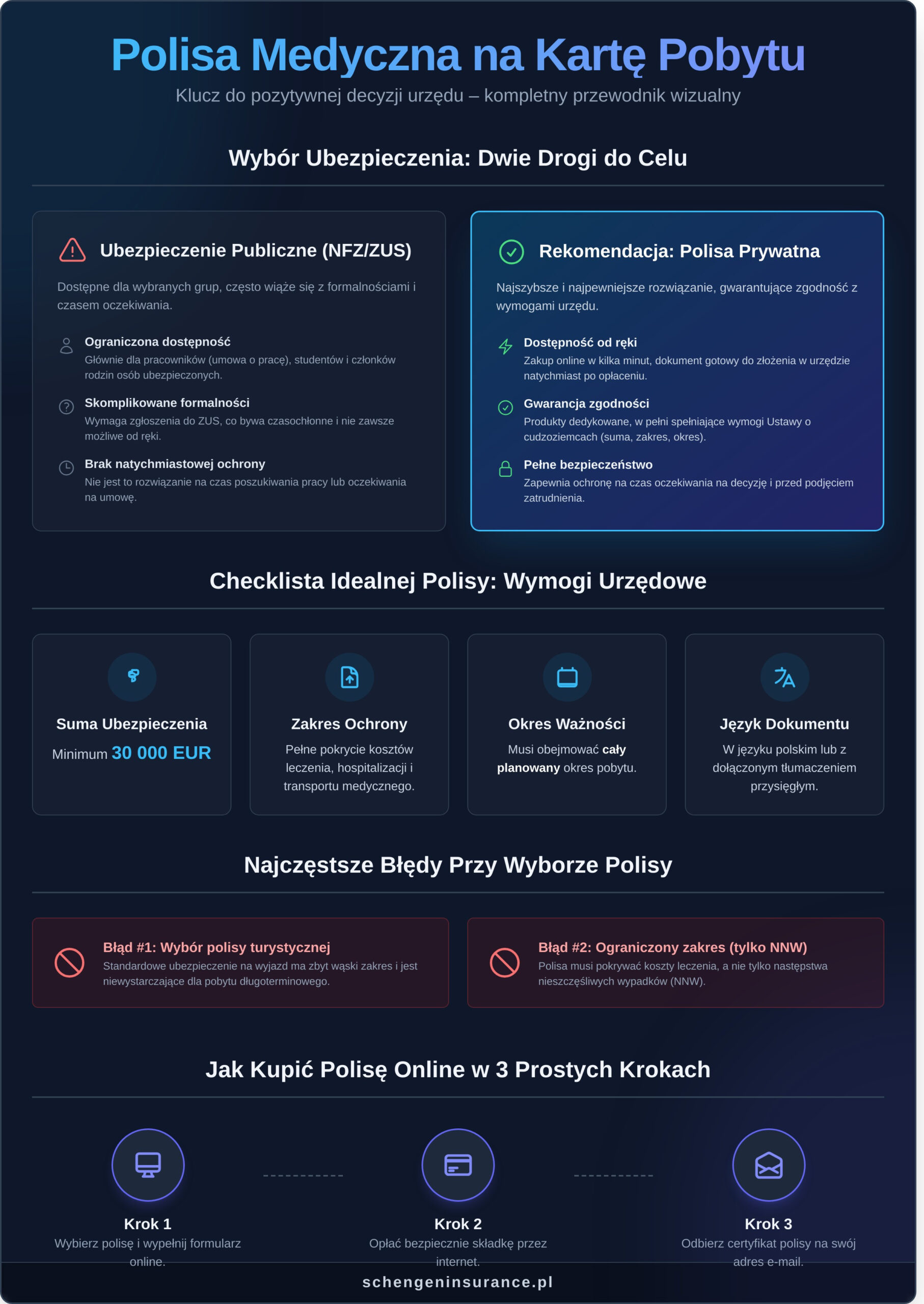
It is crucial to understand that standard travel insurance, designed for short-term trips, is insufficient in the procedure for a residence card. Its coverage is usually limited and does not meet the statutory requirements for long-term residency. It should also be distinguished from public security schemes, such as European Health Insurance Card (EHIC), which is intended for EU citizens during a temporary stay in another member country. Relevant medical policy for residence card must guarantee a wide range of benefits, covering primarily medical expenses (up to a sum insured of no less than €30,000), and not just accidental consequences (NNW). This is comprehensive health coverage, not just a safety net in case of an emergency.
Types of insurance accepted: National Health Insurance, Social Security or private policy?
A foreigner applying for a temporary residence permit in Poland is required to have valid health insurance. Provincial offices accept several types of documents confirming protection, but the choice of a particular solution is crucial to the efficiency and success of the entire process. Analyzing the available options, their costs and the associated paperwork allows you to make an informed decision and avoid delays in administrative proceedings.
Public insurance (NFZ/ZUS).
Insurance under the National Health Fund (NHF), most often carried out through application to the Social Insurance Institution (ZUS), is available to certain groups of foreigners. It can be used primarily by persons employed under an employment contract, students enrolled by a university or family members of an already insured person. The document required by the office is usually a current ZUS RCA registered report. The main disadvantage of this solution is its limited availability - not everyone is eligible, and the application process can be complicated and time-consuming. This is problematic especially for those who are just looking for employment or waiting for a contract to be finalized.
Private medical policy - a dedicated solution
Specialized medical policy for residence card represents the fastest and surest solution, designed to meet specific official requirements. Its key advantages are:
- Off-the-shelf availability: Buying a policy online takes just a few minutes, and a certificate of insurance is generated immediately after the premium is paid, ready to be attached to the application.
- Compliance Guarantee: Insurers offer products that fully respect the official insurance requirements, including the required minimum sum insured (€30,000) and coverage for medical expenses.
- Flexibility: This is an ideal safety net while waiting for a decision from the office or before taking a job that entitles you to Social Security coverage.
By choosing a dedicated policy, the applicant receives a ready-made document, which eliminates the risk of formal errors and significantly simplifies the entire process. While public insurance is perfectly acceptable, a private medical policy is often the most convenient and reliable way to quickly complete the formalities of applying for a residency card.
What should the ideal medical residency card policy be? Checklist
Choosing health insurance for a residence card application is much more than a formality. It is one of the key documents that is reviewed in detail by an official. Errors or omissions in the policy can result in a call for supplemental documentation and, in extreme cases, even a denial of permission. To avoid complications, consider the following points as a checklist to ensure that your medical policy for residence card will meet all legal requirements and provide real protection.
Note that a low price should not be the only criterion. A policy that does not comply with the requirements of the Foreigners Act will be rejected, which will generate additional costs and delay the entire process.
Sum insured and territorial coverage
The basic parameter verified by the authority is the sum insured. According to the current regulations, The minimum amount must be EUR 30,000. The policy must also guarantee coverage of medical expenses in the territory of the Republic of Poland. However, it is worth considering choosing a variant with a higher sum insured. In the event of a serious accident or complicated hospitalization, the cost of treatment can quickly exceed the legal minimum, and a higher amount provides full financial security and peace of mind.
Coverage: what must the policy cover?
For insurance to be accepted, it must cover a broad catalog of medical benefits. The official will check that the policy guarantees coverage for any costs that would have to be paid by public funds in the absence of insurance. Key elements include:
- Hospital treatment costs (hospitalization).
- Coverage for expenses related to a sudden illness or accident.
- The cost of medical transportation to a medical facility.
- Costs of transporting remains to the country of origin (repatriation).
Treatment fees in Poland can be very high for those not covered by the National Health Fund system. Learn more about Costs of treatment of a foreigner in Poland.
Important provisions in the contract: what to pay attention to?
The devil is in the details, which is why you should carefully study the General Insurance Terms and Conditions (GIC) before you buy. Pay particular attention to three aspects. First, the policy may not contain provisions on deductible, which means that the insurer must cover 100% of the cost of benefits. Secondly, the validity period must cover the entire time for which you apply for residency. Crucially, the insurance must be active at the time of the decision. Third, the insurer must be a credible entity. To make sure it meets all the criteria, it is worth checking official government insurance requirements.
The most common mistakes when buying a policy and how to avoid them
The process of applying for a residency card is complex and requires meticulous preparation of documentation. One of the key attachments is proof of health insurance. Unfortunately, an error in the policy is one of the most common reasons for a deficiency call, which in practice can delay the entire procedure by up to several months. Awareness of potential pitfalls is crucial to avoid a negative decision by the office.
To make it easier to verify the document before submission, we have prepared a summary of the most common mistakes, dividing them into substantive and formal. Choosing a proven supplier that specializes in products for foreigners minimizes the risk of their occurrence.
Factual errors in the policy
Even if a policy has been purchased, its contents may not meet statutory requirements. The provincial office carefully analyzes the scope and terms of coverage. The most common errors in this area are:
- Too low a sum insured: According to the regulations, the minimum sum insured must be €30,000. Any policy with a lower coverage amount will be automatically rejected.
- Choosing a travel policy: Standard travel insurance is for short trips and is not accepted in the residence permit procedure. A dedicated medical policy for residence card, covering a wide range of services, including inpatient treatment.
- Unauthorized Disclaimers: The document must not contain clauses that exclude coverage in the event of exacerbation of chronic diseases. The official shall review the General Terms and Conditions of Insurance for such provisions.
Formal and procedural errors
A substantively correct policy may be challenged due to formal deficiencies. It is imperative to verify the following before visiting the office:
- Document language: The policy must be presented in Polish. If it was issued in a foreign language, it is necessary to attach a sworn translation.
- No proof of payment: The application must be accompanied by proof of payment of the premium for the entire period for which the permit is to be issued. Submission of an unpaid certificate is equivalent to a missing document.
- Personal data errors: Any, even the smallest mistake in name, surname, date of birth or passport number can be grounds for rejection of the policy. The data must 100% match the passport.
Avoiding the above mistakes is crucial to the smooth and successful completion of the residency legalization process. The safest approach is to use an insurer that guarantees full compliance of its products with the requirements of provincial offices. Choose a reliable solution and check our offer.
How to buy a residence card policy online in 5 minutes? Step by step
The process of applying for a residency card involves many formalities. However, thanks to modern solutions, purchasing mandatory health insurance does not have to be one of them. We present a simple and fully secure process that allows you to obtain the required policy in just a few minutes, without leaving home. Buying online is all about saving time and convenience, as well as a guarantee that you will receive a document accepted by the authorities immediately after payment.
Step 1: Select the period and variant of insurance
The first step is to precisely match the policy with the formal requirements. You need to choose the period of insurance coverage, which must be consistent with the period for which you apply for a residence card (usually 12 months). It is also crucial to indicate the sum insured - according to the Law on Foreigners, the minimum amount is €30,000. Our system automatically proposes variants that meet these criteria, taking into account the purpose of the stay, such as work or study, which ensures full compliance with the expectations of the office.
Step 2: Fill in your information and pay the premium
After selecting a policy variant, the system will ask you to complete a short form. Only the basic data of the insured person, such as name, surname, date of birth and passport number, are necessary. Then pay the premium using one of the available secure payment methods:
- Quick online transfer (Przelewy24)
- Payment by card (Visa/Mastercard)
- BLIK
The entire transaction is encrypted with an SSL certificate, which guarantees full protection and confidentiality of personal information.
Step 3: Pick up and print the finished policy
This is the last and fastest stage. Immediately after the payment is credited, the complete medical policy for residence card in PDF format will be automatically sent to the e-mail address provided in the form. The received document is ready to print and is an official proof of insurance, which is fully accepted by all Provincial Offices in Poland. If you lose your email, recovering your policy is extremely easy - just contact our customer service department.
The entire process is designed to make one of the key formalities as simple as possible. Find out how quickly and efficiently you can get the required insurance on the schengeninsurance.co.uk.
Summary: Secure your stay in Poland with the right policy
As we have demonstrated in this guide, choosing health insurance is one of the fundamental steps on the road to obtaining a residency card. It's not just a bureaucratic requirement, but more importantly a real protection for your health and finances. It's crucial that your policy has the right amount of coverage and scope of benefits to ensure compliance and avoid rejection of your application for formal reasons.
Avoiding the most common mistakes, such as inadequate protection or selecting an offer that is not accepted by the authorities, is now easier than ever. Properly structured medical policy for residence card is a document you can obtain fully online, saving you time and eliminating uncertainty. It's an investment in peace of mind throughout the legalization process.
Don't let paperwork complicate your plans. Choose a solution that provides guarantee of acceptance by all Provincial Offices in Poland. Our policy meets the stringent requirements of the Foreigners Act and is ready to file in just 5 minutes. Take care of your future today. Buy online a medical policy accepted by the authorities! Successful passage through the residency legalization process is within your reach.
Frequently Asked Questions (FAQ)
Will insurance from my home country be accepted in Poland?
According to the Foreigners Act, the insurance policy must meet strict requirements. The insurer must be based in the EU, EFTA or Switzerland. Policies from third countries often do not cover all required benefits, such as medical expenses for a minimum of €30,000. To avoid the risk of rejection, it is advisable to purchase a policy from a proven insurer operating in Poland, which guarantees compliance with the requirements of provincial offices.
For how long do I have to buy a policy when applying for a residence card for 3 years?
The legal requirement is clear: health insurance must cover the entire period for which the temporary residence permit is applied for. When applying for a 3-year residence permit, a policy valid for the entire period must be submitted. For long-term policies, insurers often offer the option of paying the premium in convenient annual installments, making it easier to manage your finances while still meeting the formal requirements of the office.
What happens if the authority extends the proceedings and my policy expires?
The applicant is required to have valid insurance throughout the administrative procedure. If your policy expires before the decision is issued, the provincial office will call for the formal deficiencies to be corrected by providing a new, valid document. You should immediately purchase a new policy and deliver it to the office to avoid negative consideration of your application due to failure to meet the statutory requirements.
Do I need to carry a physical copy of the policy with me, or will an electronic version suffice?
When applying for a residency card at the provincial office, a printed copy of the policy is required. An electronic version, such as a PDF on your phone, may not be accepted as an official document. In everyday situations, such as when visiting a doctor, the digital version may be sufficient, however, it is recommended that you also carry a physical copy with you for safety and to avoid possible complications.
What is the difference between a residence card policy and insurance for a national visa?
The basic requirements, such as a sum insured of at least €30,000, are identical for both types of documents. The main difference lies in the required period of coverage. Insurance for a national visa must cover the entire period of its validity, i.e. a maximum of 1 year. In contrast, a properly selected medical policy for residence card must be valid for the entire requested permit period, which can be up to 3 years, making it a long-term commitment.
Can I also insure my family members on the same policy?
Yes, most insurers offer family policies that allow you to cover all family members under one contract. This is convenient and often more financially advantageous. However, make sure that each family member applying for a residency card is named in the policy, and that the coverage for each person meets the statutory requirements. The authority will require proof of insurance for each applicant individually.





 Polish
 English
 Russian
 Turkish
 Indonesian
 Ukrainian
 Vietnamese
 Spanish