
The process of applying for a visa or residence card in Poland can sometimes be a source of great stress. Fear of rejection due to an invalid insurance policy, complicated legal terminology and time pressure are challenges that many foreigners face. JTBD Validation: Not only do you need a document, but most importantly, you need the confidence that your health insurance is 100% compliant and will be seamlessly accepted by an official. No more uncertainty or language barrier - this guide was created to give you peace of mind and control over the formalities.
In this comprehensive guide for 2026, we will take you step-by-step through all the steps involved in selecting and purchasing mandatory health insurance for foreigners. You'll learn the minimum legal requirements for the amount of insurance and coverage, how to distinguish between a policy acceptable to the authorities and one that may expose you to problems, and how to quickly and safely obtain the necessary document online. Our goal is to ensure that your application for legalization of residence in Poland is successful.
Why is health insurance for a foreigner mandatory in Poland?
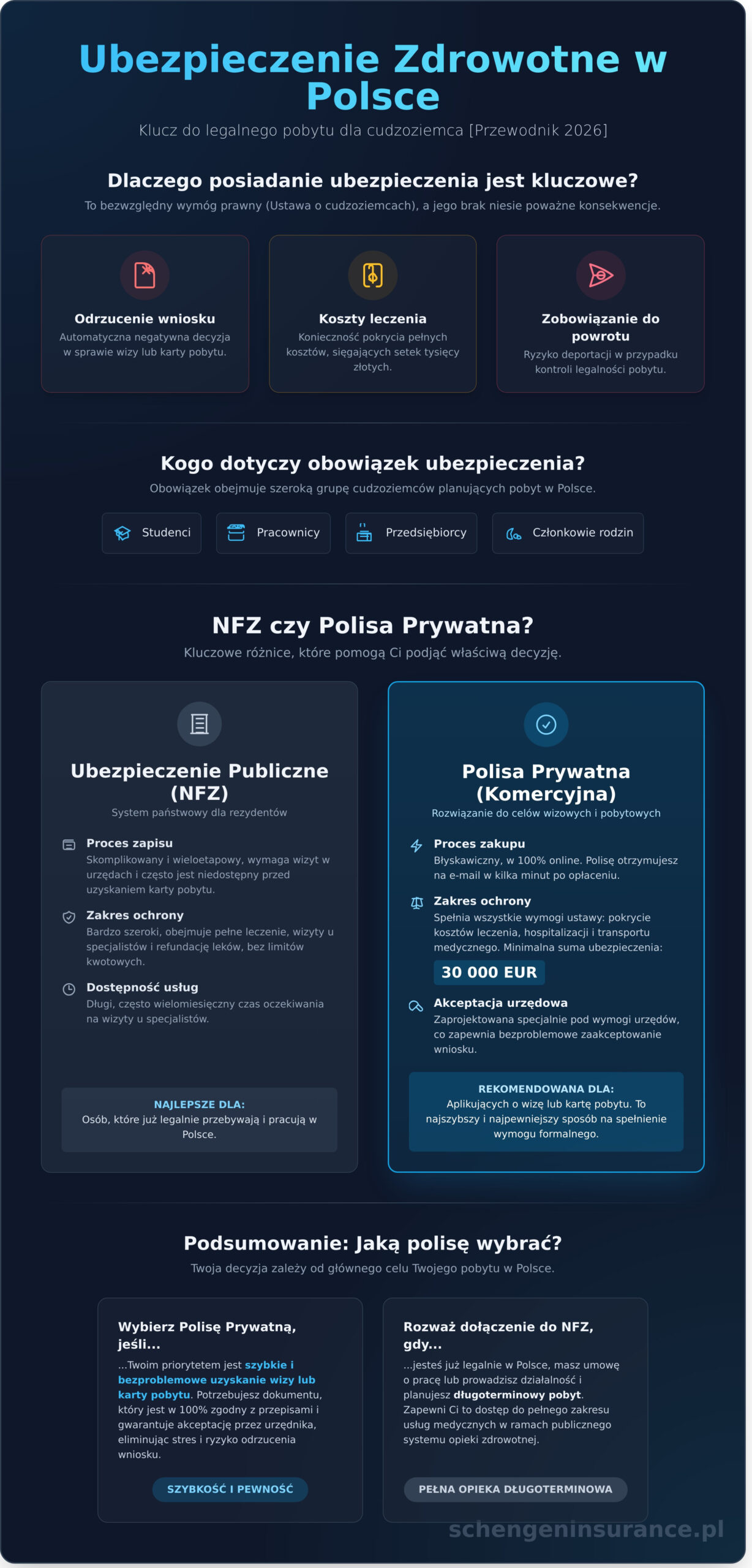
Having health insurance for a foreigner staying in Poland is not an option, but an absolute legal requirement. This regulation is intended to provide dual protection: to safeguard the foreigner from potentially high medical costs and to protect the financial stability of the health care system in Poland. A proof of policy is one of the key attachments required when applying for a visa or residence permit. Understanding this requirement as a fundamental need is the first step to ensuring your safety and legality of your stay.
Legal basis: the Law on Foreigners
The main legal act governing this issue is the Law on Foreigners. According to its provisions, any person from outside the European Union applying for a national visa or temporary residence permit must document possession of health insurance. The policy must cover all medical expenses on Polish territory, including hospitalization and medical transportation. The main purpose of the policy is to fulfill this formal official requirement.
Who is affected by the insurance obligation?
This obligation is broad in scope and applies to almost all foreigners planning to stay longer than a tourist. Regardless of the individual motivations of each group, the fundamental need for insurance remains the same. The main groups required to have a policy include:
- Students entering Polish universities.
- Employees employed under employment contracts or civil law contracts.
- Persons engaged in business activities.
- Family members of Polish citizens or other foreigners legally residing in Poland.
There are a few exceptions to this rule. For example, holders of the Polish Charter may, upon meeting certain conditions, gain access to public health care under the rules applicable to Polish citizens.
Consequences of not having a valid policy
Failure to carry valid health insurance carries serious legal and financial consequences. Failure to have an adequate policy is one of the most common causes of negative official decisions. Consequences can include:
- Automatic rejection of the application For a visa or residence card.
- The need to cover the full cost of treatment with their own funds, which can amount to tens or even hundreds of thousands of zlotys.
- Issuance of a decision on the obligation to return (deportation) in the case of control of legality of stay.
A properly conducted analysis of the customer's needs shows that avoiding these acute risks is a key motivation for purchasing adequate insurance. What's more, an in-depth understanding of these consequences underscores that the main task of the policy is not only to cover medical expenses, but first and foremost to provide legal and financial security.
Types of insurance in Poland: National Health Fund vs. Private Policy
Any foreigner planning to stay in Poland is required to have adequate insurance coverage. The choice comes down to two main paths: the public system under the National Health Fund (NHF) and a commercial private policy. The fundamental difference lies in their purpose, scope and availability. Understanding these dissimilarities is crucial, as the right choice depends directly on the status and main purpose of the stay - whether it is to get a job, start studying, or the need to quickly fulfill the formal requirements for a visa or residence card.
Public insurance (NFZ): Who can join and how?
Access to state health care under the National Health Service is mandatory for contracted and self-employed workers. Students can also be covered, often on preferential terms. The main advantage of the public system is the very wide range of medical benefits, including hospital treatment, visits to specialists and reimbursement of medicines, with no imposed quota limits on treatment. However, the system comes with significant drawbacks: a complicated and time-consuming registration procedure and long, often months-long waiting times for visits to specialists.
Private insurance: when is it the best option?
A private policy is often not just an alternative, but a necessity, especially in the context of visa paperwork. For a foreigner, whose main concern is to obtain a visa or residence card quickly and smoothly, the process JTBD Validation: (i.e., validating the task to be performed) clearly points to commercial insurance as the optimal tool. It is designed to meet specific insurance visa requirements, including a minimum sum insured of €30,000. The main advantages are the ability to buy online in a few minutes, immediate protection and the certainty of acceptance by authorities, which eliminates the stress of the application procedure. The disadvantages may be the limited sum insured and the narrower scope of benefits compared to the National Health Fund, focused mainly on sudden illness and accidents.
Comparative table: key differences
| Criterion | Public insurance (NHF) | Private policy |
|---|---|---|
| Cost | Monthly premium, dependent on income | One-time fee for the selected protection period |
| Recording process | Complicated, multi-stage, requires visits to authorities | Fast, in 100% online, in minutes |
| Scope of protection | Very wide, with no quota limits | Limited to the sum insured (e.g., €30,000) |
| Acceptance for visa | Not always sufficient or obtainable in time | Guaranteed, meets all legal requirements |
| Access to a doctor | Long waiting times for appointments with specialists | Quick, often in private facilities |
Check out our policy that meets all official requirements.
Key requirements that the policy for visa and residence card must meet
For anyone applying for a visa or residence card, this section is the most important checklist. Failure to meet even one of the following formal requirements inevitably leads to rejection of the application, generating unnecessary stress and delays. Understanding these criteria is a key part of the process, which can be seen as a kind of JTBD Validation - confirmation that the chosen insurance product actually accomplishes the fundamental task of securing residence formalities. It should be emphasized that every policy offered by Schengen Insurance is 100% compliant with current regulations, which guarantees full security and acceptance by the authorities.
Minimum sum insured: EUR 30,000
European Union regulations precisely stipulate that the minimum coverage amount of medical insurance must be at least €30,000. This threshold has been set to ensure that the policy will cover the potentially high costs of emergency hospital treatment, medical interventions or sanitary transport, without burdening the public health systems of the member states. It is an absolute minimum amount, and its value must be clearly indicated in the policy document. The absence of this information or a lower amount is grounds for immediate disqualification of the application.
Territorial scope: validity in the entire Schengen area
The requirement to have insurance is not limited to the territory of Poland. The policy must be valid in all Schengen countries. This means that protection is provided not only in Poland, but also when traveling to countries such as Germany, France, Italy, Spain or the Czech Republic. This is directly related to the fundamental principle of freedom of movement - the holder of a visa or residence card has the right to travel throughout the zone, and his insurance must follow him, guaranteeing protection in each of these places.
Coverage: What must the insurance cover?
For a policy to be approved, its coverage must cover strictly defined medical events. The goal is to provide comprehensive coverage for the most serious situations, which is in line with the guidelines, which you can read more about by examining the following official information from the National Health Fund concerning health care systems. Mandatory elements of protection are:
- Sudden illness and accidents: coverage of medical expenses for situations that arose unexpectedly during the stay.
- Costs of hospitalization and inpatient treatment: Full coverage of costs associated with hospital stays, including treatments, surgeries and necessary examinations.
- Medical transportation to the country of residence: so-called medical repatriation, i.e. covering the costs of transporting the insured to his homeland, if his health condition allows it, but prevents his return by standard means of transport.
- Costs associated with death: Covering the costs of transporting the deceased to the insured's country of origin.
A meticulous examination of these four pillars of protection is crucial to a successful application. It is the precise alignment of the offer with these requirements that is the result of our internal analysis, which we define as JTBD Validation, ensuring that our policy fully accomplishes the task set by the client and the authorities.
How to choose and buy the right insurance? Step-by-step process
Selecting and purchasing mandatory medical insurance is a key step in the process of applying for a visa or residence card. While it may seem like a complicated formality, in reality the process has been simplified to ensure maximum security and convenience. The following step-by-step guide will walk you through all the steps, from defining your needs to receiving a completed policy. Think of it as a personal JTBD Validation: - you make sure that the product you choose perfectly addresses your fundamental need, which is a hassle-free and legal stay in Poland.
Step 1: Determine the purpose and length of stay
The basis is to precisely match the policy to the purpose and timeframe of your stay. The type of document required - domestic visa, Schengen visa or residence card - determines the minimum conditions the insurance must meet. It is crucial that the validity period of the policy covers the entire planned duration of your stay, from the day of entry to the day of departure. Failure to cover this period may result in the rejection of the application, so always carefully check the dates appearing on the visa application or residence permit decision.
Step 2: Check the credibility of the insurer
Choosing an insurer is a decision about your safety and the success of official paperwork. Pay close attention to a few key aspects that ensure your policy will do its job:
- Specialization: Does the insurance company have experience in offering policies for foreigners? Dedicated products, such as those offered by SchengenInsurance.co.uk, are designed to meet all statutory requirements.
- Acceptance by authorities: The most important criterion is a guarantee that the policy is accepted by all provincial offices in Poland and Polish consulates. Information on this should be clearly and explicitly stated by the insurer.
- Customer reviews: Verifying the opinions of others who have already gone through the process can provide valuable information about a company's reliability and quality of service.
Step 3: Purchase your policy online - quickly and securely
The process of buying insurance online is currently the most efficient method, saving time and avoiding unnecessary paperwork. The entire procedure closes in a few simple steps. To fill out the form, you will need basic data such as name, surname, date of birth and passport number. After making a secure online payment, the finished policy document is sent to your email address in just a few minutes. Make sure that the certificate you receive is in Polish or English, which is a requirement when submitting documents to the authority.
The most common mistakes when choosing insurance and how to avoid them
The process of applying for a visa or residence card is complex, and every detail matters. Choosing the right medical insurance is one of the key steps, where it is easy to make a costly mistake. Our in-depth analysis of your needs, or what we call a "needs assessment. JTBD Validation:, makes it clear that the customer's real task is not simply to „buy insurance,” but to „meet the formal requirements and get approval to stay.” Understanding this goal allows you to identify the most common pitfalls and effectively avoid them.
Mistake 1: Choosing travel insurance instead of a policy for a foreigner
A basic and unfortunately common mistake is to buy a standard travel policy. While its name may suggest travel protection, its scope and purpose are quite different. Travel insurance rarely meets the detailed legal requirements set by foreigners' offices, such as the minimum sum insured (€30,000) or repatriation coverage. What is crucial to the official is the name and purpose of the policy, which must clearly indicate that it is intended for an applicant for a visa or temporary stay.
Mistake 2: Incorrect policy validity period
The insurance policy must cover whole the requested period of stay. A common mistake is to buy protection for a shorter period of time, such as until the date of the scheduled decision, rather than for the entire year requested. To avoid rejection for this reason, it is advisable to add a few days of provision to the end date. Equally important is the start date - protection must be effective from the first day of the planned stay in Poland, as specified in the visa or residence card application.
Mistake 3: Policy from unknown company not accepted by authorities
The choice of insurer is of fundamental importance. Policies issued by companies outside the European Union or those that are not well established on the Polish market are often questioned by provincial offices. This is due to the lack of certainty about the insurer's actual solvency and ability to pursue claims in Poland. The offices prefer policies from proven, local companies that guarantee real protection. Don't risk delays or rejection of your application due to an unreliable document. Choose a secure solution. Our policies are accepted nationwide.
Health insurance for foreigners - key to legal stay and peace of mind
As we have demonstrated in this guide, having adequate health insurance is not only a legal obligation for every foreigner in Poland, but more importantly the foundation of a safe stay. It is crucial that the policy you choose meets strict formal requirements, such as a minimum sum insured of €30,000 and adequate coverage, which is necessary to obtain a visa or residence card. Avoiding the most common mistakes in practice means JTBD Validation: Making sure that a key piece of paperwork is seamlessly accepted by the official.
To make the process as simple as possible, we offer policies that are accepted by all Provincial Offices in Poland and fully meet the requirements of the Foreigners Act and EU regulations. Don't risk delays or rejections. Buy a foreigner's health policy online in 5 minutes, and you will receive the finished document immediately to your e-mail address after payment. Take care of your paperwork today and enjoy a peaceful stay in Poland.
Frequently Asked Questions (FAQ)
Will health insurance from my country be accepted in Poland?
Typically, health insurance from outside the European Union is not honored by Polish provincial offices or consulates. In order for an application for a visa or residence card to be granted, the policy must meet specific statutory requirements. These include a sum insured of at least €30,000 and coverage for medical treatment and hospitalization. The safest option is to choose a policy from an insurer approved by Polish state authorities.
What is the difference between insurance for a type D national visa and a type C Schengen visa?
The main difference is based on the length and purpose of the stay. Insurance for Schengen visa type C is for short-term stays, up to 90 days within a 180-day period. In contrast, a Type D national visa policy is required when applying for a long-term stay of more than 90 days, such as for study or work. In both cases, the insurance must be valid for the entire period of the planned stay and meet the minimum coverage requirements.
As a student, do I have to have insurance if the university does not require it?
Yes, having health insurance is mandatory for any foreigner applying for a national visa or residence card to study, regardless of the university's internal regulations. This requirement follows directly from the Law on Foreigners. The absence of a valid medical policy covering medical expenses on Polish territory is grounds for denial of a residence permit. Ensuring adequate protection is a key element of the paperwork.
What exactly should I do if I get sick and need to use my insurance in Poland?
In the event of a sudden illness or accident, immediately contact the insurer's Emergency Center, which is available 24 hours a day. Provide your policy number and describe the medical situation. The consultant will indicate the nearest medical facility with which the insurer has a contract and arrange for assistance. In life-threatening situations, you should first call an ambulance (112) and then inform the Emergency Center.
For how long do I have to buy a policy when applying for a residence card for 3 years?
When applying for a temporary residence permit for 3 years, it is not required to present a policy for the entire period. According to the practice of provincial offices, you must present health insurance valid for at least 12 months. After obtaining the decision and before the expiration of the policy, you should take care to renew it in order to maintain continuity of insurance coverage throughout your legal stay in Poland and avoid formal complications.
Can I buy insurance for my family member who is just planning to come?
Yes, it is possible to purchase an insurance policy for a family member who is still abroad. The person making the contract (the policyholder) may be different from the person covered (the insured). This is a standard procedure, as having valid medical insurance is one of the basic requirements to be fulfilled already at the stage of visa application at the Polish consulate abroad. The completed policy will be sent to the e-mail address indicated.


 Polish
 English
 Russian
 Turkish
 Indonesian
 Ukrainian
 Vietnamese
 Spanish