
Going to work abroad or moving to Poland involves a lot of paperwork, and the issue is dual health insurance in Poland and abroad, raises the most questions. Do I have to deregister from the National Health Service? Am I in danger of paying double premiums? Or is my foreign policy sufficient? These doubts, arising from complicated regulations, can lead to unnecessary stress and costly mistakes, and in extreme cases even to a lack of medical coverage.
In this comprehensive guide, we dispel any confusion. We explain precisely in what situations you can legally have health insurance in two countries, what rules apply to Poles working in the European Union and foreigners taking up employment in Poland. Step by step, we discuss your obligations to the Social Insurance Institution (ZUS) and the National Health Fund (NFZ), as well as explain the key differences between protection in the public system and that provided by a private policy. After reading this article, you will gain the confidence and knowledge necessary to consciously manage your health security, in accordance with current regulations.
Key EU principle: One country, one health insurance
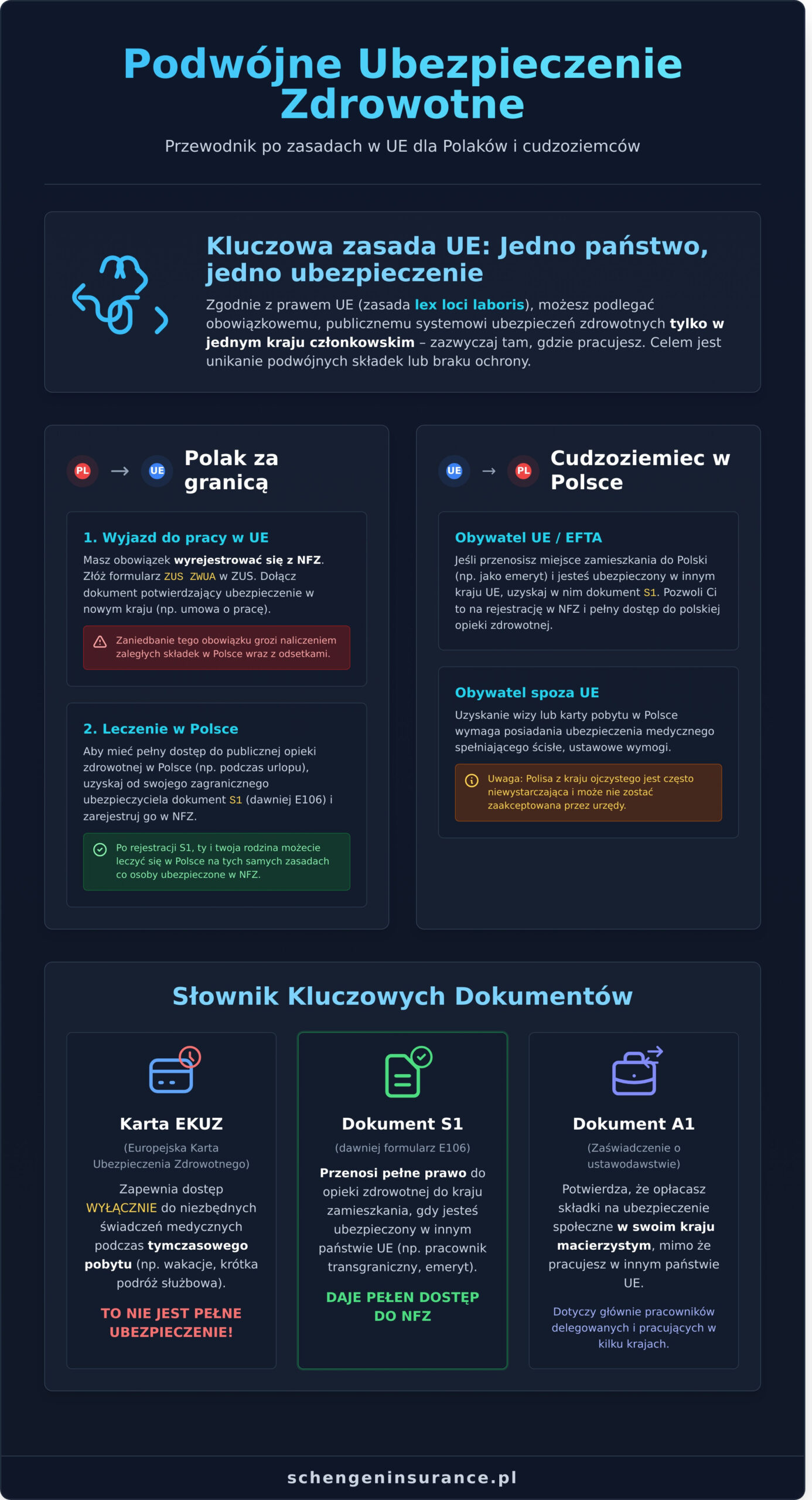
Social security systems in the European Union and EFTA member states are subject to strict coordination. The purpose of these regulations is to protect the rights of citizens moving between countries in order to avoid a situation in which a person pays double contributions or, on the contrary, is deprived of insurance protection. The fundamental rule is the principle of being subject to the legislation of only one member state, usually the one in which the work is performed (the principle of lex loci laboris). It should be emphasized that this applies to public, mandatory insurance systems, such as Poland's National Health Fund (NFZ) and Germany's Krankenkasse.
What does the 'principle of one legislation’ mean in practice?
In practice, this rule means that a person cannot simultaneously be covered by compulsory health insurance in the NFZ and in an analogous institution in another EU country. Taking up a job abroad, as a rule, involves the obligation to deregister from insurance in Poland. Keeping dual health insurance in Poland and abroad within the public systems leads to serious administrative complications, including problems in determining which institution is competent to cover medical expenses.
The role of A1 and S1 documents in the EU system
To avoid confusion and unambiguously confirm which legislation a person is subject to, standard EU documents are used. The A1 document is crucial for posted workers and those working in several countries - it certifies that social security contributions are paid in the home country. The S1 document, on the other hand, entitles a person to full health care coverage in his or her country of residence, even though insurance is paid in another country (e.g., in the case of pensioners).
EHIC card vs. dual insurance - common misunderstandings
A common mistake is to confuse having an EHIC card with having dual insurance. The EHIC card, or European Health Insurance Card, only confirms the right to necessary medical services during a temporary tourist or professional stay in another EU/EFTA country. It does not replace insurance in the country of permanent residence and does not give full access to health care. Its possession is therefore not equivalent to having insurance in two countries.
Pole abroad: Responsibilities and rights related to insurance
Taking a job in another European Union member state is the most common scenario of labor emigration for Poles. According to the principle of coordination of social security systems, a working person is subject to the legislation of only one country - usually the one in which he performs work. This means an obligation to deregister from the Polish health care system and pay contributions abroad. Neglecting these formalities can lead to serious financial consequences, including a situation where unauthorized dual health insurance in Poland and abroad.
The process of deregistration from the National Health Service when leaving for work
A key obligation of a person starting work in another EU country is to inform the Polish contributor of this fact. A form must be submitted to the Social Insurance Institution ZUS ZWUA for deregistration from insurance. It is advisable to attach to the application a document confirming insurance coverage in the new country (for example, an employment contract). Failure to de-register will result in the NFZ charging overdue premiums with interest, even if the premiums were regularly paid abroad.
Treatment in Poland on the basis of insurance from another EU country
To ensure that you have full access to public health care in Poland during your vacation or regular visits, you must obtain a document from your foreign insurer S1 (formerly E106). This document should then be registered with the provincial branch of the NFZ competent for the place of residence in Poland. After registration, the insured person and his family members gain the right to treatment in Poland on the same terms as those insured in the NFZ, and the costs of services are covered by the foreign institution.
Posted and cross-border workers - exceptions to the rule
There are special situations in which an employee may remain in the Polish insurance system. A posted employee, sent by a Polish employer to work abroad for up to 24 months, retains insurance in Poland, as evidenced by a document A1. Similarly, a cross-border employee (living in Poland and working in a neighboring country) may be subject to specific regulations. In complex cases, where work is performed in several countries, the relevant legislation is determined on a case-by-case basis.
Foreigners in Poland: Mandatory policy vs. insurance in the country of origin
The legal situation of foreigners with regard to health insurance in Poland varies and depends on their country of origin. Other regulations apply to citizens of the European Union and others to those arriving from outside the Community. Understanding these differences is key to successfully legalizing your stay and ensuring full medical security.
EU citizens in Poland: Transfer of treatment rights
Citizens of EU/EFTA member states, during their temporary stay in Poland, can receive public emergency health care on the basis of the European Health Insurance Card (EHIC). However, if they move their residence to Poland - such as a retiree from Germany - they should obtain an S1 document in their home country, which allows full transfer of treatment entitlements and registration with the NFZ. According to EU regulations, one is subject to the social security system of only one country. Detailed EU health insurance rules specify that a person working in Poland must be insured here, even if he or she holds citizenship of another EU country.
Non-EU foreigners: Policy requirement for visa and residence card
For third-country nationals, Polish immigration law imposes an absolute obligation to have adequate medical insurance as a condition for obtaining a visa or residence card. A policy from one's home country is often insufficient, as it must meet strict requirements set forth in the law. These include:
- The minimum sum insured of EUR 30,000.
- Coverage for any expenses that may arise during your stay due to the need to return for medical reasons, urgent medical attention, emergency hospital treatment or death.
- Validity for the entire period of the requested stay and coverage of medical expenses by the insurer on the basis of the issued bill.
The insurance must be reliable and accepted by Polish administrative authorities. Find a policy accepted by provincial offices, which guarantees full compliance with current regulations.
National Health Insurance vs. private policy for a foreigner - is it double insurance?
Initially, a private policy is necessary for entry and legalization of residence. However, once a foreigner takes up legal employment, full-time studies or establishes a business, he or she most often obtains title to mandatory insurance from the National Health Fund (NHF). Is it therefore problematic dual health insurance in Poland and abroad? Absolutely not. Having both forms of coverage is fully legal and often very beneficial. A private policy can be a valuable complement to National Health Insurance benefits, providing access to private facilities, reducing waiting times or covering unreimbursed costs.
Public insurance (NHF) vs. private policy: Can and should they be combined?
Many myths have grown up around the subject of health insurance. It should be made clear that having dual insurance under the public systems of two different countries (e.g., Poland and Germany) is, in principle, impossible due to EU social security coordination rules. What is different, however, is the combination of public health care under the National Health Fund with a private policy. Such a solution is fully legal and often provides optimal coverage, combining the broad coverage guaranteed by the state with the speed and convenience offered by commercial insurers.
Differences in scope and purpose of the two systems
The basic discrepancy stems from the nature of the two systems. Insurance in the National Health Fund (NHF) is mandatory for those who meet statutory criteria (e.g., employees) and is universal in nature. It provides very broad access to services, but its limitation can be the long waiting time for an appointment with a specialist or a scheduled procedure. A private policy, on the other hand, is voluntary, and its scope is precisely defined in the contract. Its main purpose is to ensure quick access to doctors, examinations and treatment, and, in the case of foreigners, to meet the formal requirements for legalization of residence.
Practical scenarios in which it makes sense to have both policies
The combination of the two forms of protection is particularly beneficial in the following situations:
- Foreigner with a work visa: At the stage of visa formalities, a private policy is required. Once he starts working legally, he becomes covered by the National Health Service, but having an additional private policy still guarantees him faster access to specialists.
- A worker employed in Poland: A person covered by mandatory insurance with the National Health Service often opts for an additional private policy to avoid queues and have access to a wider network of medical facilities.
- Non-EU student: He is required to have private health insurance for the entire period of study. In some cases, he can also voluntarily join the National Health Insurance, which provides him with a full spectrum of protection.
Is a private policy from abroad honored in Poland?
This is a key issue for visitors to Poland. A foreign policy, even one with broad coverage, most often is not accepted by Polish offices as a document for obtaining a visa or residence card. This is due to the fact that insurance must meet specific requirements set forth in the Polish Law on Foreigners. Although a foreign policy can be honored in private clinics on a commercial basis, it does not constitute the required formal security. Therefore, a dedicated policy purchased in Poland, meeting all official requirements, is a solution that guarantees safety and security during the residency legalization process.
Dual health insurance: key findings and some solution
As our guide shows, navigating health care regulations can be complicated. It is crucial to remember the fundamental EU principle of being subject to the insurance system of only one country. Understanding how the dual health insurance in Poland and abroad, avoids misunderstandings and administrative problems, both for Poles working abroad and foreigners coming to Poland. Remember that for foreigners, an adequate policy is not only a protection, but above all a legal requirement for legalization of stay.
If you are a foreigner and need a secure solution that meets all the paperwork, don't take a chance. Choose a policy that guarantees security and acceptance. Our insurance is fully compliant with the requirements of the law on foreigners and honored by all voivodship offices in Poland. The purchase process is extremely simple - you will complete the entire procedure online, and you will receive the finished document to your email in just a few minutes. Don't let paperwork stand in the way of your goals.
Buy online insurance for foreigner - accepted by authorities! Ensure your peace of mind and security today.
Frequently Asked Questions (FAQ)
Can I be insured at the same time with the National Health Service and the German health insurance fund (Krankenkasse)?
According to EU regulations on the coordination of social security systems, a person can only be covered by statutory health insurance in one member state. This means that, as a rule, it is not possible to pay contributions and be insured simultaneously in the Polish NFZ and the German Krankenkasse. The country responsible for insurance is usually the country in which the work is performed, which precludes dual, parallel insurance in the public systems.
I work in the Czech Republic, but live permanently in Poland. Where should I pay my health premiums?
According to the principle of priority of the place of work, health insurance premiums should be paid in the Czech Republic. As a cross-border worker, once registered in the Czech insurance system, you should apply for an S1 document. This document, after registration with the Polish branch of the NFZ, entitles you to receive health care in Poland on the same terms as those insured with the NFZ, despite paying premiums abroad.
I am coming to study in Poland from Ukraine. Is insurance purchased in Ukraine enough for a residence card?
Insurance purchased in Ukraine may not be sufficient to obtain a residence card in Poland. Polish regulations require that a medical policy for a foreigner cover medical expenses on Polish territory for at least €30,000 and be valid for the entire period of the planned stay. Provincial offices verify the policy's compliance with these requirements. It is recommended to buy insurance from a company whose policies are approved by Polish government offices.
What happens if I mistakenly pay double health insurance premiums in two EU countries?
Having dual health insurance in Poland and abroad (in another EU country) is not in compliance with the regulations on coordination of social security systems. You should contact the insurance institutions in both countries as soon as possible to clarify the situation and determine which country is competent to collect contributions. Once the correct legislation has been established, it is possible to claim reimbursement of undue premiums paid for the period during which dual insurance was in effect.
I have private health insurance. Does this exempt me from paying National Health Insurance premiums if I work in Poland under a contract of employment?
No, having a private health insurance policy does not exempt you from paying premiums to the National Health Fund (NFZ). In Poland, anyone employed under a contract of employment is subject to mandatory health insurance with the National Health Fund, and premiums are automatically deducted from wages by the employer. Private insurance is an additional and voluntary product that expands access to medical care, but does not replace the public health care system.
Do I need to translate my foreign policy into Polish when applying for a visa?
Yes, as a rule, documents submitted to Polish offices as part of administrative proceedings, including for a visa or residence card, must be in Polish. This requirement also applies to an insurance policy. If the policy is in a foreign language, it is necessary to attach a sworn translation of it into Polish. Failure to provide a translation may result in a call to supplement formal deficiencies and a delay in processing the application.






 Polish
 English
 Russian
 Turkish
 Indonesian
 Ukrainian
 Vietnamese
 Spanish