
The process of applying for a Polish national (type D) visa can be complicated, and the fear of rejection due to an incorrect policy is one of the biggest sources of stress. Unintelligible, specialized contract language and uncertainty about whether insurance from a particular company will be accepted by the consulate can be effective sleep deprivation. Correctly selected insurance for national visa is not just a formality - it is the foundation on which the success of the entire procedure and your safety during your stay in Poland depends.
In this complete guide for 2024, we will dispel all your doubts and guide you through the maze of regulations. Step by step, we will explain what specific requirements a medical policy must meet to guarantee a successful application. You will learn what amount of insurance to pay attention to, what coverage is mandatory, and how to quickly and seamlessly buy online a policy that on 100% will be accepted by the authorities. Ensure peace of mind and confidence that your application is complete and correct.
What is a national visa (Type D) and why is insurance mandatory?
When planning to stay in Poland for more than 90 days, it is necessary to obtain a national visa, marked „D”. This is a document that entitles you to long-term residence and, depending on the purpose, also to work, study or join your family. In accordance with the general visa definitions, it is a permit to cross the border and stay in the country. A key element, without which a visa application cannot be granted, is the possession of an appropriate medical policy. This obligation is designed to ensure that any foreigner staying in Poland has financial security in case of sudden health problems.
National visa versus Schengen visa - key differences
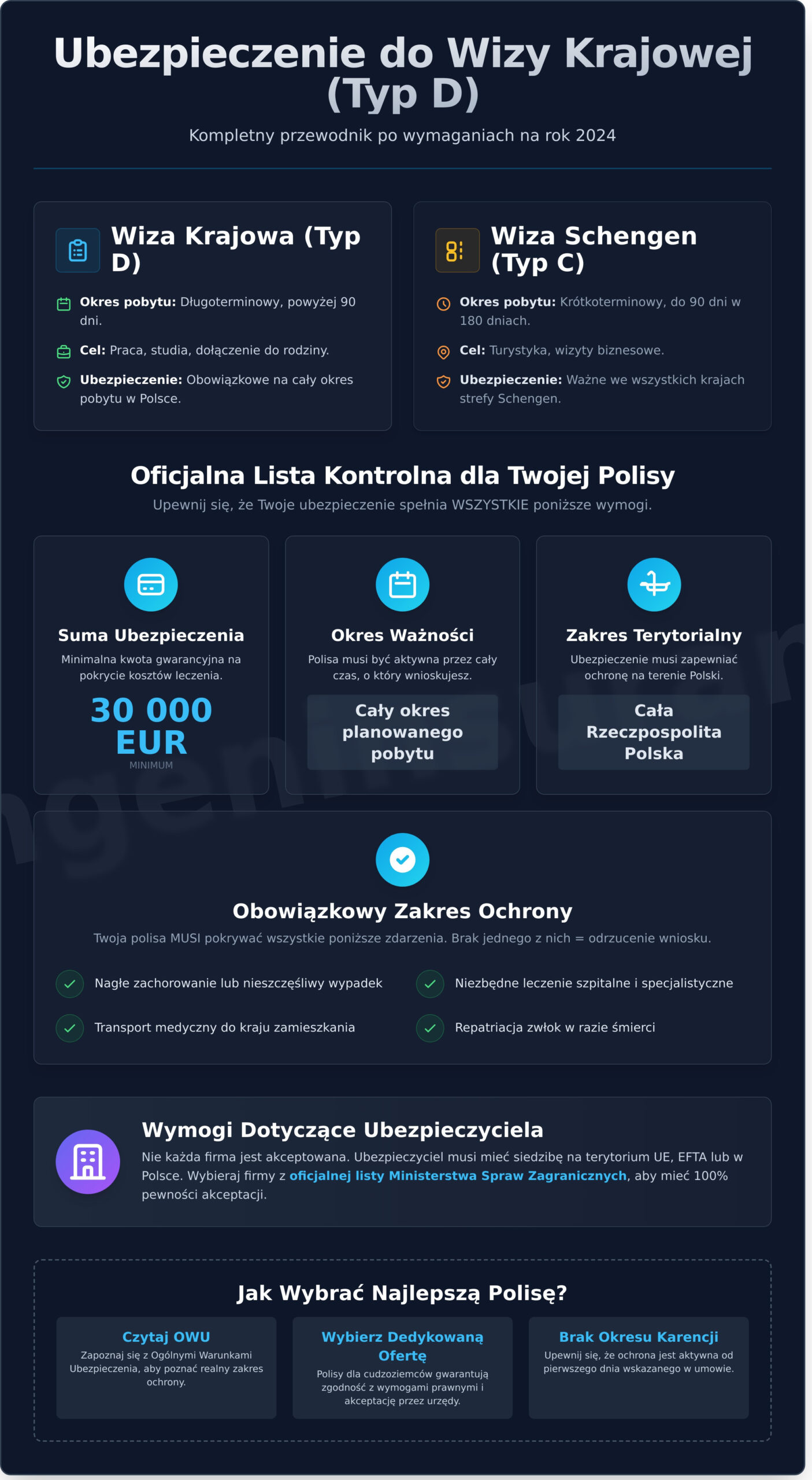
Although both visas allow entry into Poland, their purpose and formal requirements differ significantly. Understanding these differences is fundamental to choosing the right insurance coverage. The most important discrepancies are:
- Period and purpose of stay: A national visa (Type D) is for long-term stays (more than 90 days), usually for business, education or family purposes. A Schengen visa (Type C) is for short-term stays (up to 90 days in any 180-day period) for tourism or business purposes.
- Insurance requirements: In the case of a Schengen visa, the insurance must be valid for all countries in the zone and cover at least the first planned entry. In contrast, insurance for national visa must be in effect for the entire declared period of stay in Poland, providing comprehensive medical coverage.
Legal basis: the Law on Foreigners
The requirement to have medical insurance is not a suggestion, but a strict formal condition based on Law of December 12, 2013 on foreigners. The regulations precisely stipulate that an applicant for a national visa must document possession of travel medical insurance with a minimum sum insured of EUR 30,000. The purpose of this provision is to protect the Polish health care system from financial burdens that could result from the treatment of foreigners without coverage. In practice, this means that the lack of a valid policy or the presentation of a document that does not meet the statutory criteria leads to the mandatory rejection of a visa application.
Formal requirements for insurance for national visa - official checklist
In order for a national visa application to be granted, the submitted insurance policy must absolutely meet a number of strict criteria. Consular and provincial offices meticulously verify each of the following points, and any non-compliance may result in the rejection of the application. The following list should be considered an official guide to ensure that the selected insurance for national visa Is in full compliance with the law. It is also always a good idea to verify the current official visa requirements directly on government websites to be sure of the applicable regulations.
Sum insured and validity period
The basic requirement is a minimum guarantee amount, which must be at least EUR 30,000. This is the amount intended to cover any unforeseen medical expenses. It is equally important that the policy is valid for the entire period of your planned stay in Poland, for which you are applying for a visa. Considering a higher sum insured can provide additional peace of mind and broader protection in the event of more complicated and expensive medical interventions, the cost of which could exceed the legal minimum.
Territorial coverage and scope of protection
Insurance must be in force in the territory of the entire Republic of Poland. Also key is the scope of benefits, which obligatorily must include all of the following. The absence of any of these in the policy is grounds for rejection by the official.
- Medical expenses resulting from a sudden illness or accident.
- Necessary hospital and specialized treatment.
- Costs of medical transportation to the country of permanent residence.
- Coverage for repatriation of remains in the event of death of the insured.
Insurer requirements
Not every policy from any insurance company will be accepted. According to the regulations, the insurer must be based in a member state of the European Union, a member state of the European Free Trade Association (EFTA) or in Poland. Companies outside this area must meet additional stringent conditions, such as passing an audit and ensuring that claims can be asserted in the territory of Poland. The Ministry of Foreign Affairs publishes a list of verified and accredited insurers, which significantly facilitates the selection of a reliable partner.
How to choose the best insurance? Comparison of quotes and key aspects of the policy
Choosing the right policy is a decision that affects not only your budget, but more importantly, your sense of security during your stay in Poland. The lowest price is rarely an indicator of the best offer, so it is crucial to carefully read the General Insurance Conditions (GIC). This document specifies the actual scope of protection. It should be noted that policies dedicated to foreigners are optimized in terms of legal requirements, which significantly facilitates the entire visa application process and gives certainty of acceptance of the document by the consul or governor.
It is also worth noting additional benefits, such as liability in private life, which protects against the financial consequences of damage caused to third parties. Importantly, in the case of policies for foreigners, there is usually no so-called grace period, which means that the insurance coverage is active from the first day indicated in the contract.
Analysis of the scope of protection: what do the provisions mean in practice?
Understanding the key terms in the T&Cs is essential to assessing the value of a policy. Among the most important are:
- Sudden Illness: It is a medical condition arising unexpectedly, requiring immediate medical intervention. Examples include acute appendicitis, influenza with high fever or food poisoning.
- Unfortunate accident: It is defined as a sudden event caused by an external cause that results in physical injury, such as a broken leg due to a slip.
- Disclaimers: Each policy contains a list of situations in which the insurer will not cover costs. Most often, these relate to the treatment of chronic diseases that existed before the contract was taken out or events that occurred under the influence of alcohol.
Assistance services - your support in emergencies
An integral part of a good policy is assistance services. A 24/7 emergency center (hotline) is the first and most important point of contact in case of health problems. With one phone call, a consultant can arrange a doctor's appointment, arrange medical transportation, and even provide interpreter assistance during a consultation. This is real support that is invaluable in a stressful situation, especially in a foreign country.
Price comparison: what does the cost of insurance depend on?
The cost it has insurance for national visa, is dependent on several fundamental factors. Understanding them allows you to make an informed choice of an offer. The main elements that affect the price are:
- Length of protection period: The longer the planned stay in Poland, the higher the insurance premium will be.
- Age of the insured: Insurance risks are statistically higher for older people, which can affect the cost of a policy.
- Sum Insured: A higher coverage amount (e.g. €50,000 instead of the minimum €30,000) means a slightly higher price, but also broader, safer financial protection.
To find out the exact cost of a tailored policy, it is best to use a dedicated tool. Check the price of insurance for a national visa in our calculator!
The process of buying insurance online - fast, safe and free of paperwork
In the digital age, the complicated paperwork involved in obtaining a visa has been greatly simplified. The purchase of the mandatory insurance for national visa via the Internet is a solution that saves valuable time and avoids unnecessary stress. The entire process is designed to be intuitive and fully secure, and most importantly, the policy is generated immediately after payment and ready to be attached to the visa application.
Step 1: Fill out the form and select a variant
The first step involves accurately completing the data in the online form. It is crucial that all the information matches the data in the passport to prevent possible formal problems. It is necessary to provide:
- Personal information of the insured: Name, surname, date of birth and passport number.
- Period of insurance coverage: The exact start and end dates of the stay in Poland.
- Insurance Option: Choice of sum insured (in accordance with the minimum requirement of €30,000) and possible extensions of coverage.
Step 2: Payment and receipt of policy
After verifying the entered data, the system will redirect to a secure payment gateway. Transactions can be made using the most popular methods, such as payment card (credit or debit) or quick online transfer. All connections are encrypted, which guarantees full data protection. Immediately after the payment is credited, complete insurance documents in PDF format will be sent to the email address provided, including:
- Insurance Policy Certificate.
- General Insurance Terms and Conditions (GIC).
Step 3: Attach the policy to the visa application.
The certificate you receive is an official document that must be printed and attached to the set of documents submitted to the consulate or office. It serves as proof that you have the required medical insurance for the entire period of your planned stay. It is always a good idea to keep a digital copy or an extra printout of the policy for yourself in case of unforeseen situations. A properly purchased online policy is fully accepted by all Polish consular posts.
The entire process on the platform schengeninsurance.co.uk has been optimized to provide maximum convenience and assurance that your insurance for a national visa meets all formal requirements.
Insurance for visa vs. other forms of health care in Poland
The process of applying for a national visa involves understanding the specifics of the Polish health care system. Foreigners often face the dilemma of which form of insurance is appropriate at the application stage, and which will be available only after arrival and legalization of stay. Clarifying these differences is key to avoiding formal errors and ensuring full protection.
Private insurance vs. insurance in the National Health Service
The basic and most important principle is to distinguish the point at which the various forms of protection become available and required. Private insurance for national visa is an obligatory document to be attached to the visa application, so it must be purchased before planned arrival in Poland. Its purpose is to secure the foreigner from the first day of his stay.
Access to public health care under the National Health Fund (NFZ) is possible only after certain conditions have been met, such as starting a legal job, beginning studies or running a business in Poland. Thus, registration with the NFZ takes place as soon as you arrive and complete the formalities. Moreover, the scope of NFZ benefits does not include the cost of medical repatriation, i.e. medical transport to the country of origin, which is an absolute requirement under visa regulations. For this reason, public insurance cannot be the basis for obtaining a visa.
EHIC card - why is it not accepted?
The European Health Insurance Card (EHIC) is another document that is sometimes mistakenly considered sufficient security. However, it should be strongly emphasized that the EHIC Card is not accepted in the process of applying for a national D visa. This is due to several fundamental reasons:
- The purpose of the card: The EHIC is a document designed for citizens of European Union member states, the EEA or Switzerland, entitling them to receive medical care during temporary stays (e.g. tourist stays) in other member states.
- Limited scope: The card only provides access to essential medical services on the same basis as nationals. It does not meet the broad visa requirements, which include, among other things, coverage of all medical expenses up to €30,000 and the aforementioned repatriation.
- Inaccessibility to third-country nationals: Applicants for a Polish national visa are generally not entitled to an EHIC card in terms of its primary function.
In summary, the only form of health protection accepted by Polish consulates at the visa application stage is a dedicated medical policy from a private insurer. Such a policy is a guarantee that all formal requirements will be met and provides real security at the beginning of your stay in Poland. By choosing a proven insurance for national visa, you gain confidence that the application will not be rejected due to formal deficiencies.
Insurance for a national visa: A summary and a sure step forward
As you go through the process of applying for a D national visa, it becomes crucial to understand that an adequate medical policy is not an option, but an absolute legal requirement. As highlighted in our guide, it is the foundation of your safety and peace of mind during your stay in Poland, protecting you from unforeseen medical costs. Keep in mind that the policy must meet the strict criteria set forth in the Foreigners Act, including a minimum sum insured of €30,000 and broad coverage that includes hospitalization, outpatient treatment and medical transportation.
Choosing the right one insurance for national visa However, it does not have to be complicated or time-consuming. Instead of risking rejection due to a non-compliant policy, it is worth trusting a solution that was created specifically for this purpose. Our offer eliminates all doubts, guaranteeing full compliance with current regulations and trouble-free acceptance by all Polish consulates and provincial offices.
Don't let paperwork stand in the way of your plans. Ensure solid protection and complete your visa requirements in the easiest way possible. The entire purchase process takes just a few minutes, and you will receive the complete documents directly to your email address, ready for submission to the office.
Buy online a policy for a national visa accepted by the authorities!
Frequently Asked Questions (FAQ)
How much does insurance cost for a national visa for a year?
The cost of annual insurance for a national visa depends on several key factors, such as the age of the insured, the sum insured and the coverage chosen. Typically, the annual premium ranges from about PLN 500 to PLN 1,500. The exact price can be precisely calculated using an online calculator, allowing you to tailor the offer to your individual needs and formal requirements for your stay in Poland.
Is insurance needed for work and student visas?
Yes, having adequate medical insurance is mandatory for both work and student visa applications. This requirement stems directly from the Foreigners Act and is one of the key conditions for obtaining a national type D visa. The policy must provide medical coverage for a minimum amount of €30,000 and be valid for the entire planned period of stay in the Republic of Poland.
What happens if my visa application is denied? Will I receive a refund?
If you receive a visa denial, it is possible to apply for a refund of the insurance premium paid. To do this, you need to provide the insurer with an official document confirming the visa refusal, issued by the consulate. After verification of the documents, we will refund the funds for the unused period of coverage, in accordance with the general terms and conditions of insurance. The procedure is simple and is designed to safeguard the interests of our clients.
Can I buy insurance when I arrive in Poland?
No, medical insurance must be purchased before submitting a visa application. This is one of the mandatory documents that must be presented to the consul during the application procedure. Lack of a valid policy at the time of application will result in rejection. Therefore, it is crucial to take care of all the paperwork, including the purchase of adequate insurance, even before visiting the diplomatic post.
What documents will I receive after I buy a policy online?
After purchasing the policy online, all necessary documents will be immediately sent to your email address in PDF format. You will receive a certificate of insurance (policy), which is the official confirmation of the contract and should be printed and attached to the visa application. The message will also include the General Terms and Conditions of Insurance (GIC), detailing the scope of coverage and procedures to be followed in the event of an incident.
Do I need to translate the policy into Polish?
Our policies are prepared in several languages, including Polish and English, to meet the requirements of consulates. Usually, a document issued in English is accepted by Polish offices and does not require an additional sworn translation. Nevertheless, having a Polish-language version eliminates any potential doubts. By choosing our insurance for a national visa, you will receive a document that fully complies with the expectations of officials.


 Polish
 English
 Russian
 Turkish
 Indonesian
 Ukrainian
 Vietnamese
 Spanish