
The visa application process is often a source of uncertainty, and one of its key elements is choosing the right policy. Fear of rejection by the consulate, the intricacy of insurance terms or the conviction of complicated formalities are common problems. However, it is important to remember that a properly selected insurance for Schengen visa is not only an obligatory document, but, above all, the foundation of a sense of security during your stay in Europe. It is a guarantee of peace of mind and the assurance that you will receive the necessary medical attention in case of unforeseen emergencies.
This article is designed to dispel any doubts and guide you through the process in a methodical and easy-to-understand manner. In our complete step-by-step guide, you will learn what specific legal requirements a policy must meet in order to be guaranteed approval by all authorities. We will explain how to consciously choose the coverage tailored to your needs and how to finalize the purchase online - quickly, safely and without unnecessary complications. You'll gain confidence that your visa paperwork is buttoned up to the last button, and you're fully prepared for your trip.
Why is insurance for Schengen visa compulsory? Legal basis
A Schengen visa is a document that entitles a person to enter and stay in the territory of the 29 countries that make up the area without internal border controls. Any person applying for such a visa is required to provide proof of an adequate medical policy. This requirement is not an arbitrary decision of the consulate, but derives directly from EU law, specifically from Regulation (EC) No. 810/2009 of the European Parliament and of the Council, known as the Community Code on Visas. The purpose of this obligation is twofold: on the one hand, it protects the traveler from potentially very high medical costs abroad, and on the other hand, it protects the health care systems of member states Schengen area against the financial burden of treating uninsured foreigners.
The lack of a valid and compliant policy is one of the most common reasons for formal rejection of a visa application. Therefore, a properly selected insurance for Schengen visa is the foundation for the successful completion of the application procedure and a guarantee of a safe stay.
Key requirements that your policy must meet
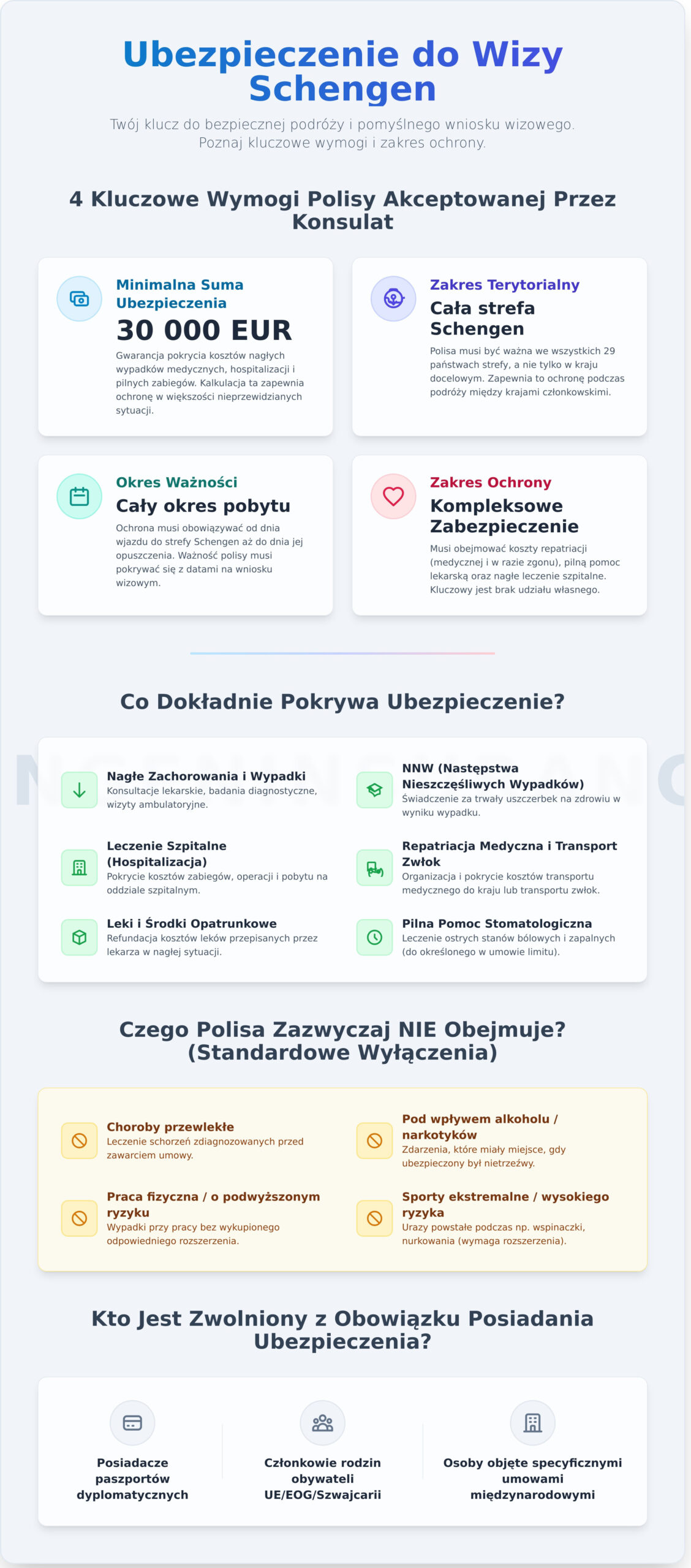
In order for a policy to be accepted by a consulate or embassy, it absolutely must meet the four basic criteria set forth in EU regulations:
- Minimum sum insured: EUR 30,000. This amount was calculated as a threshold to guarantee coverage for most medical emergencies, including hospitalization, urgent surgery or medical transportation.
- Territorial scope: The insurance must be valid throughout the Schengen area, not just in one destination country of travel.
- Validity period: The policy must cover the entire planned period of stay, counting from the day of crossing the zone until the day of departure.
- Scope of protection: The coverage must mandatorily include any expenses related to repatriation for medical reasons, urgent medical attention, emergency hospital treatment or death.
Who is exempt from the insurance requirement?
Although the requirement to have insurance is the rule, there are well-defined exceptions to it. The following groups of people are exempt from this obligation:
- Diplomatic passport holders.
- Family members of EU, EEA or Swiss citizens who exercise their right to free movement.
- Persons whose status is governed by specific international agreements that provide for exemption from this obligation.
In any other case, presentation of a valid policy is a prerequisite for obtaining a visa.
How to read and understand the policy? Key terms and coverage
The insurance policy document may seem complicated, but understanding it is key to ensuring your complete security. It is important to remember that mandatory insurance for Schengen visa is a product with a well-defined scope that must meet the minimum requirements set by the European Union. In accordance with official visa regulations, the policy must guarantee coverage of at least €30,000 in medical expenses and be valid throughout the Schengen area. A key feature that distinguishes it from many standard travel insurance policies is the complete absence of a deductible - this means that the insurer covers 100% medical expenses up to the sum insured, without the insured person having to commit any of his or her own funds.
What exactly does the sum insured of €30,000 cover?
The minimum sum insured of €30,000 is a guarantee of coverage for a wide range of sudden and unforeseen medical events. In practice, this means that the insurer will cover costs associated with:
- Sudden illness and accidents: This includes the cost of medical consultations, necessary diagnostic tests (e.g., X-rays, blood tests) and outpatient visits.
- Inpatient treatment (hospitalization): If you need to be hospitalized, the policy covers the cost of treatments, surgeries, medical care and ward accommodations.
- Purchase of necessary medicines and dressing supplies: Medicines and medical supplies prescribed by a doctor in connection with a sudden illness or accident are reimbursed.
- Urgent dental care: Insurance usually covers treatment of acute inflammation and pain, but up to a contractually specified limit (e.g., €200-250).
Additional key elements of protection: NNW and repatriation
Standard medical insurance for foreigners also includes other extremely important elements that provide comprehensive protection in difficult situations:
- NNW (Personal Accident): This is a benefit paid when an accident results in permanent injury. The amount of compensation depends on the severity of the injury and the amount of NNW insurance.
- Medical Repatriation: If the insured's state of health makes it impossible to return to the country of residence by standard means of transportation, the insurer will arrange and pay for medical transportation.
- Transportation of corpses: In the most tragic case - the death of the insured person - the policy covers the cost of transporting the body to the country of origin or burial at the place of death.
Standard exclusions of liability: what does the policy not cover?
Every insurance policy has a list of situations in which coverage does not apply. You should familiarize yourself with them before purchasing. Among the most common exclusions are:
- Treatment of chronic diseases that were diagnosed before the date of the insurance contract.
- Events that occurred while the insured was under the influence of alcohol, drugs or other intoxicants.
- Accidents occurring during the performance of manual labor or high-risk work, if an appropriate extension of coverage has not been purchased.
- Injuries resulting from extreme or high-risk sports (e.g., climbing, scuba diving), unless the policy has been extended with an appropriate clause.
How to choose and buy Schengen visa insurance online? Step by step process
The decision to purchase an insurance policy is a key part of preparing for a visa application. While a traditional visit to a land-based agent is still possible, buying online offers an unparalleled advantage in terms of speed, convenience and 24/7 availability. The entire process can be finalized in minutes, without leaving home. However, it is crucial to choose a reliable insurer and seller whose policies are fully accepted by consulates and authorities. Always verify that the company has transparent insurance terms and positive customer reviews.
Step 1: Select the period and variant of insurance
Precise determination of policy dates is absolutely fundamental. The insurance must cover the entire period of the planned stay in the Schengen zone, from the day of entry to the day of departure. It is wise practice to take out a policy for a period several days longer than the planned trip. This provides a safety buffer in case of unforeseen delays or changes in plans. Then choose a variant of protection - basic, which meets the minimum visa requirements (sum insured of €30,000), or extended, which offers higher sums and additional benefits, such as private life liability.
Step 2: Filling out the form and payment
The online purchase process requires basic personal information about the insured person. The necessary information is usually:
- Name (according to passport)
- Date of birth
- Passport number
- Email address to which the policy will be sent
The most common mistake is to enter data with typos. Pay special attention to the correctness of writing the name and passport number, as a mistake can result in the invalidation of the document. Payments are made through secure systems, such as online transfers, BLIK or credit card, which guarantees the protection of transactions.
Step 3: Receipt and verification of the policy
After payment, ready insurance for Schengen visa in the form of a PDF file is immediately sent to the e-mail address provided. Before submitting the document to the consulate, verify it carefully. Check the correctness of personal data, dates of coverage, sum insured, and territorial coverage (it must cover all Schengen countries). Although a digital policy is valid, it is recommended to print it for visa purposes. In accordance with the requirements, which are confirmed by official information from the Polish Ministry of Foreign Affairs, the document must be legible and complete, and a physical copy makes it easier for officials to verify.
Meet the formal requirements without unnecessary complications. Buy an accepted policy online in 5 minutes!
What to do after the purchase? How to use insurance in the Schengen area
Purchasing a policy is a key step in the application process, but its true value is revealed in emergency situations. Your insurance for Schengen visa is not only a document required by the consulate, but, above all, a real financial and organizational security during your stay abroad. It is crucial to know how to use it. It is a good idea to write down the policy number and the 24-hour telephone number of the emergency (assistance) center in your phone and on a separate sheet of paper kept in your wallet.
Management of sudden illness or accident
In the event of any medical event, the first and most important step is to contact the insurer's emergency center. This is especially important in situations requiring hospitalization, complicated treatment or medical transportation. Before making a phone call, prepare the following information:
- Insurance policy number.
- Name of the insured person.
- Exact location and contact phone number.
- A brief description of the incident and the type of assistance needed.
The emergency center consultant will direct you to the appropriate medical facility and, if possible, arrange for non-cash assistance, taking over the payment formalities.
How to report the damage and claim reimbursement?
Insurers offer two basic forms of medical settlement. Non-cash settlement is when the emergency center directly pays for services at a medical facility. The second option is reimbursement - you pay the bills yourself, and when you return to the country, you apply for reimbursement of the expenses incurred. To do this, it is necessary to collect complete medical records and all original bills and invoices. The claim must be made within the timeframe specified in the General Insurance Terms and Conditions (GIC).
What if a Schengen visa is denied?
A negative decision by the consulate does not mean the loss of funds paid for the insurance premium. If you do not receive a visa, you have the right to cancel the policy and receive a full refund. To do this, you must provide the insurer with a copy of the negative decision. It is also worth remembering that properly selected insurance for Schengen visa is flexible. If you change your travel plans, most insurers allow you to change your coverage period dates free of charge before the trip begins. Do you have questions? Get in touch with our experts.
Insurance for Schengen visa - security and peace of mind at your fingertips
As we have shown in this guide, mandatory medical insurance is a fundamental part of preparing for travel and stay in the Schengen area. It is not just a formality required by authorities, but more importantly, real financial protection in case of emergencies. Understanding the key concepts of the policy, from the sum insured to the scope of coverage, is key to making an informed decision and ensuring complete peace of mind.
Choosing the right one insurance for Schengen visa doesn't have to be complicated or time-consuming. The online purchase process is designed to make completing the formalities as simple as possible. The most important thing is that the selected policy is fully compliant with the requirements of the European Union, guaranteeing a minimum sum insured of EUR 30,000. The solutions we offer give you this guarantee - they are accepted by all provincial offices and consulates of the Republic of Poland, eliminating the risk of application rejection due to an incorrect policy. Instant online purchase means that you will receive the finished document to your email address in just a few minutes.
Don't delay in completing this key requirement. Ensure your safety today.
Check out the offer and buy mandatory insurance online!
We wish you a successful completion of all formalities and a safe stay in the Schengen area.
Insurance for Schengen visa - frequently asked questions (FAQ)
How much does insurance cost for a Schengen visa and what does the price depend on?
The cost of insurance for a Schengen visa depends on several key factors. The most important of these are the length of the planned stay, the age of the insured person and the sum insured chosen, which must be at least €30,000 according to EU requirements. The price may also increase if the policy is expanded to include additional clauses, such as those covering high-risk sports. A precise premium calculation can be obtained by filling out the online form on our website.
Is the policy purchased on schengeninsurance.pl accepted by all Polish consulates and offices?
Yes, all insurance policies offered by schengeninsurance.pl are fully compliant with the legal requirements of the European Union and the Polish Aliens Act. Our insurance policies meet the criteria for minimum sum insured (€30,000) and coverage, which guarantees their acceptance by all Polish consulates, embassies and provincial offices in the process of applying for a visa or residence card. This is a reliable and proven solution.
Do I have to buy separate insurance for each Schengen country?
No, it is not necessary. One Schengen visa insurance policy provides protection on the territory of all Schengen countries. The document is valid in each of these countries for the entire period for which it was purchased. This simplifies travel between member states and does not require the purchase of additional separate policies for each destination country, providing convenience and continuity of insurance coverage.
Can I buy insurance while already in the territory?
Yes, the purchase of the policy is also possible when the insured person is already in the territory of Poland. The entire process is done fully online, eliminating the need to visit a facility. All you need to do is fill out the form, make a secure payment, and the policy document will be immediately sent to the e-mail address you specify. This is a fast and convenient solution, ideal for formalities related to extending legal residence or applying for a residence card.
What is the difference between insurance for a Schengen visa (type C) and a national visa (type D)?
The main difference is based on the purpose and length of stay. Insurance for a Schengen visa (type C) is for short-term stays, up to 90 days within a 180-day period, usually for tourism or business purposes. Insurance for a national visa (type D), on the other hand, is required when applying for a long-term stay permit of more than 90 days, such as for work or study. In both cases, the policy must meet certain legal requirements.
Does the insurance cover treatment related to COVID-19?
Yes, the medical insurance we offer for foreigners covers medical expenses related to an emergency illness with COVID-19. Coverage includes necessary medical visits, hospitalization, purchase of prescribed medications and diagnostic tests, if medically justified. This ensures full security and compliance with current requirements, providing assurance that in the event of a coronavirus infection, the insured will receive the necessary medical attention.
What if I lose my insurance policy document?
This is not a problem, as the policy document is delivered electronically (PDF file) to the email address you provided during the purchase. All you need to do is find the message in your inbox and download or print the document again. If you permanently delete the message, please contact our customer service department. After verifying your information, we will immediately send you a duplicate policy, ensuring continued access to a valid document.


 Polish
 English
 Russian
 Turkish
 Indonesian
 Ukrainian
 Vietnamese
 Spanish